

Three nights at The Ezba.
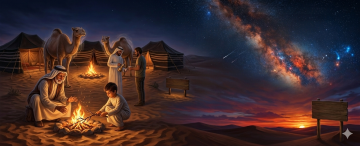
I’ve walked with camels who remember children they protected decades ago. I’ve tasted coffee poured with the left hand—a gesture of welcome so ancient it predates written history. I’ve watched a grandfather pass the flame of storytelling to his grandson, and that grandson place a branch on the fire with hands that will one day be old and weathered too.
I thought I understood now. I thought the desert had shown me everything it came to show.
Then the sun went down.
And the sky caught fire.
The Blue Hour
They call it the “blue hour”—that fleeting moment between sunset and full darkness when the world holds its breath. The desert knows this hour better than anywhere on earth.
I sat on a woven mat near the dying embers of the dinner fire. The plates of machboos had been cleared. The coffee had been poured and received. The children had been sent to sleep on cushions inside the farmhouse, their laughter fading into the soft murmur of adult voices.

Naser sat beside me, saying nothing.
For a long time, we just watched. The last orange glow bled out of the western horizon. The dunes, moments ago painted in amber and rose, turned to silhouettes—dark waves frozen against a deepening sky.
Then the first star appeared.
Not suddenly. Not dramatically. Just… there. A pinprick of light so faint I almost missed it.
“There,” Naser said softly, pointing. “That one. Do you know its name?”
I didn’t.

“In the West, you call it something else. Here, we call it Al Thurayya.” He paused. “The Pleiades. Seven sisters, you say. For us, they are a sign. When Al Thurayya rises, the cool season begins. When she sets, the heat returns. Our ancestors watched her. They knew when to plant, when to travel, when to rest.”
One star. Seven stars. A calendar. A compass. A clock.
All of it written in the sky.
The Darkness Deepens
As the blue hour gave way to true night, the stars multiplied.
First by dozens. Then by hundreds. Then by thousands.
I’ve seen stars before. I’ve camped in mountains. I’ve slept under open skies. But I have never—never—seen anything like the sky over The Ezba.

There was no light pollution here. No distant glow of the city. The nearest highway was forty-five minutes away, and even that felt like a lie. We might as well have been on another planet. Another century. Another existence.
The Milky Way appeared like a brushstroke across the heavens—a river of light so dense, so impossibly bright, that I had to remind myself it was real. That I wasn’t dreaming. That this sky has hung here for billions of years, waiting for someone to look up.
Abdulazeez appeared beside us, carrying a rolled carpet. He spread it on the sand and lay down flat, staring straight up.

“Lie down,” he said. “You’ll see more.”
I did.
And the world tilted.
The Celestial Classroom
When you lie on your back in the desert, looking straight up, something strange happens. The ground beneath you disappears. The sand, the farm, the camels, the fire—all of it fades. You become untethered. Floating. Suspended in an ocean of light.
Abdulazeez began to point.

“That line of three stars? We call them Al Jabbar—the mighty one. In the West, Orion’s Belt. Our ancestors followed them south when they needed water. And that bright one there, near the horizon? Suhail. Canopus. The star of good fortune. When Suhail appears, the sailors know the seas will calm.”
He named them one by one, these ancient navigators. Not as distant balls of burning gas, but as companions. Guides. Old friends.
“People think the Bedouin were lost in the desert,” he continued, his voice dreamy. “But we were never lost. The sky was our map. Every journey, every trade route, every migration—written here. The stars didn’t just show us where to go. They showed us when. They told stories. They taught lessons. They reminded us that we were small, yes. But also that we belonged.”

I thought about Google Maps. About GPS. About the little blue dot on my phone that tells me exactly where I am at every moment.
We have never been less lost as a species. And we have never been more disconnected from where we actually are.
The Shooting Star
We lay there in silence for what felt like hours. The adults murmured softly among themselves. The camels shifted in their enclosure, occasionally letting out low rumbles. A cool breeze swept across the dunes, carrying the smell of sand and somewhere, impossibly, the faint sweetness of dates.
Then I saw it.
A streak of light—brilliant, sudden, gone before I could even gasp—cut across the sky. A shooting star. But not the faint, hesitant kind you sometimes catch from a city balcony. This was a blade of white fire, carving its way through the Milky Way like a message from somewhere else.

I sat up, heart pounding.
“Did you—”
“Shhh,” Naser whispered. “Make a wish.”
I lay back down. Closed my eyes. And wished.
I won’t tell you what I wished for. Some things are meant to stay between a person and the sky. But I’ll tell you this: it wasn’t for me.
The Stories in the Stars
Later, when the night had deepened further and the stars had shifted noticeably in their slow dance across the heavens, Abdulazeez told us a story.
“In the old days,” he began, “there was a young Bedouin boy who wanted to prove himself. He asked his father to let him lead the caravan to the market—alone. His father refused. Too dangerous. Too many things could go wrong.”
I listened, eyes on the stars.
“But the boy was stubborn. One night, while his father slept, he took three camels and set out alone, following the stars the way he’d been taught. For three days, he traveled. And for three nights, he slept beneath the same sky we see now.”

They were directions.
Abdulazeez paused.
“On the fourth day, he arrived at the market. Proud. Triumphant. He had done it. He had proven himself.”
“What happened?” I asked.
“He sold the camels for a good price. Bought supplies for his family. And then he realized—” Abdulazeez smiled in the darkness. “He realized he had no idea how to get home. He knew the stars that led him here. But he hadn’t paid attention to the stars behind him. He only looked forward. Never back.”
The silence that followed was profound.
“The desert does not forgive those who forget where they came from,” Abdulazeez finished. “He wandered for three more days before a passing caravan found him and brought him home. His father never let him forget: the stars ahead are useless if you don’t also watch the stars behind.”
I thought about that story for a long time.
Still do.
The Final Hour
As midnight approached, the temperature dropped. Someone brought blankets—thick, woolen blankets that smelled of smoke and home. I wrapped myself in one and kept staring up.
The stars had shifted again. New constellations had risen. Old ones had begun to set. The sky was a clock, a calendar, a compass, a storybook—and I had been reading it all wrong my entire life.
Naser sat up beside me.
“You’re sad,” he said. Not a question.
I considered lying. Didn’t.
“This is my last night here,” I said. “I don’t know when—or if—I’ll see this again.”

He nodded slowly.
“You know what the Bedouin say about goodbyes?”
I shook my head.
“We don’t say goodbye. We say ila liqaa—until we meet again. Because in the desert, paths cross more than once. The wind brings people back. The stars guide them home. You will return. Maybe not next month. Maybe not next year. But the desert remembers you now. It will call you when you’re ready.”
I wanted to believe him.
I still do.
The Dawn Approaches
Too soon—always too soon—the eastern sky began to pale. Not with light, not yet. But with the faintest suggestion that darkness would not last forever.
The stars didn’t fade so much as retreat. One by one, they winked out, as if returning to some hidden place behind the veil of day. The Milky Way dissolved into memory. The constellations grew faint, then fainter, then gone.
By the time the first orange glow touched the horizon, only the brightest stars remained—Venus, maybe Jupiter, a few stubborn sentinels refusing to surrender to the sun.
And then they too were gone.

I sat up, stiff from hours on the ground, and watched the sunrise paint the dunes in colors I had no words for. Rose. Copper. Gold. Lavender. The desert awakening, shaking off the night like a great beast stirring from sleep.
Behind me, I heard the first sounds of movement—the farm coming to life. A camel lowed softly. A door creaked open. The smell of coffee, impossibly, was already in the air.
What the Stars Taught Me
Four chapters. Four nights. A lifetime of moments.
I came to The Ezba looking for a story. I found something far greater.
I found that the desert is not empty—it is full. Full of memory. Full of wisdom. Full of stars.
I found that coffee poured with the left hand is not just a drink—it is a welcome, a blessing, a bridge between strangers.

I found that camels are not beasts of burden—they are sisters, brothers, guardians, family.
I found that children who chase chickens and braid palm fronds are not just playing—they are learning to carry a flame that has burned for thousands of years.
And I found that the stars are not distant and cold—they are guides, storytellers, old friends who have been waiting for us to look up.
The Bedouin have known this for millennia. The rest of us are just now remembering.
The Final Lesson
As I packed my bag to leave, Khalid appeared at my side. The teenager who wants to be a doctor. The boy who was protected by Reema when he fell. The young man who will add wood to the fire and tell stories to his own children someday.
“You’ll come back,” he said. Not a question.
“I hope so.”

He smiled—the smile of someone who already knows something you haven’t learned yet.
“The stars don’t go anywhere,” he said. “They just wait for night to come again. And it always comes.”
He turned and walked back toward the camels, toward Reema, toward the life he was building between two worlds—the world of science and medicine, and the world of stars and stories.
I watched him go.
Then I got in the car and drove toward the city, toward the gleaming towers and the flawless roads, toward the future.
But I carried the desert with me.
I still do.
Your Turn to Look Up
The Ezba is waiting for you.
Not as a tourist. Not as a customer. But as a guest—invited to sit at the fire, to taste the coffee, to meet the camels, to lie on your back and watch the stars wheel overhead the way they have for billions of years.

Through VooTours, that invitation is open.