
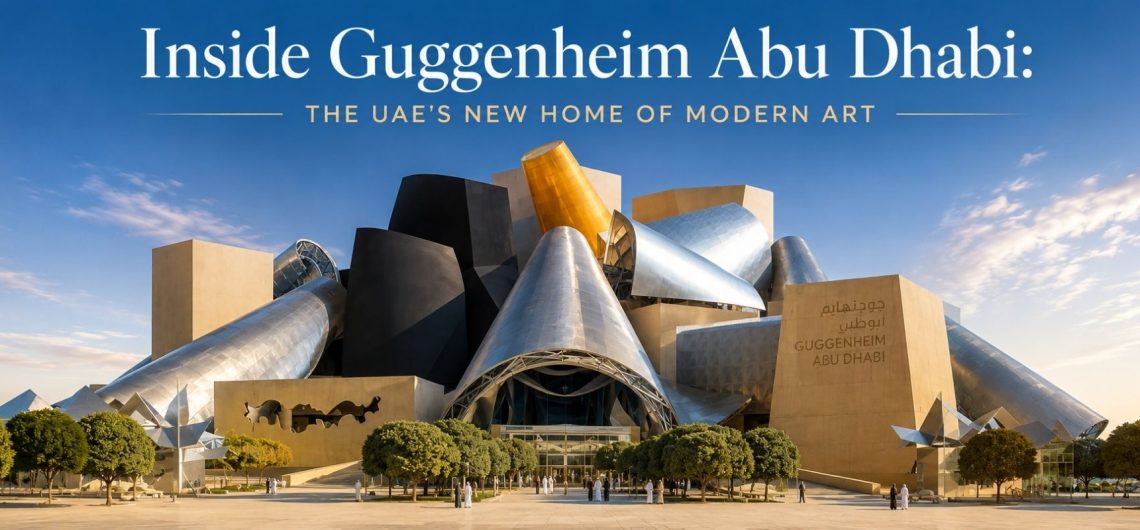
For two decades, the world has waited. On December 11, 2026, the wait finally ends.
Guggenheim Abu Dhabi is not just another museum opening; it represents the culmination of a vision two decades in the making, the final masterpiece of one of architecture’s greatest minds, and a bold statement about what art can mean in the twenty-first century.
The Long-Awaited Arrival
First announced in 2006, Guggenheim Abu Dhabi arrives nearly two decades later as the largest museum in the Guggenheim constellation—surpassing its celebrated siblings in New York, Venice, and Bilbao.
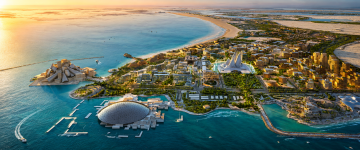
The museum joins a remarkable cultural ecosystem on Saadiyat Island, taking its place alongside the Louvre Abu Dhabi, Zayed National Museum, Natural History Museum Abu Dhabi, and teamLab Phenomena Abu Dhabi. Together, these institutions position Saadiyat Cultural District as one of the world’s most significant concentrations of cultural landmarks.
But what makes this museum truly extraordinary is not just its scale—it is the story it tells and the vision it represents.
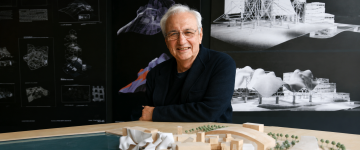
Frank Gehry’s Final Cathedral
The late Frank Gehry, who passed away in December 2025 at age 96, never saw his largest museum completed. That poignancy hangs over Guggenheim Abu Dhabi like the light that dances across its sculptural forms.
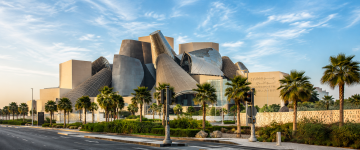
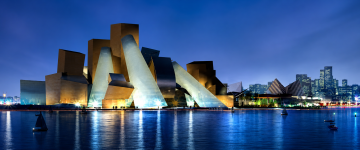
The building rises from a peninsula where land meets sea, framed by water on three sides—a position that Gehry said shaped everything about the design, from its orientation to the way sunlight moves across it through the day.
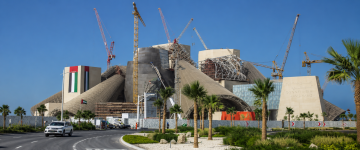
Ten sculptural cones punctuate the skyline, reaching heights of up to 88 metres. Nine are clad in stainless steel mesh, catching the Gulf sun like a mirage made solid. The tenth, taller than the others, is finished in onyx and glass—a beacon that glows from within.
But here is where Gehry’s genius truly reveals itself. These cones are not merely sculptural gestures. They draw inspiration from the wind towers found throughout traditional Gulf architecture—ancient passive cooling systems that channel air through buildings. At Guggenheim Abu Dhabi, they provide natural ventilation and shade, making the building climate-responsive in a region where air conditioning often dominates architectural thinking.
The numbers themselves are staggering:
- Total Built Area: 80,000 square metres
- Indoor Galleries: 30 galleries, 11,600 square metres
- Outdoor Exhibition Space: 23,000 square metres
- Gallery Connector: Central atrium linking all 30 galleries
This makes Guggenheim Abu Dhabi the largest museum Gehry ever designed—his final cathedral, cast in steel mesh and onyx.
A Collection Built for the World
Since 2009, curators have been building a collection that now exceeds 600 artworks. The museum focuses on modern and contemporary art from the 1960s to the present, spanning painting, sculpture, installation, photography, moving image, and new media.
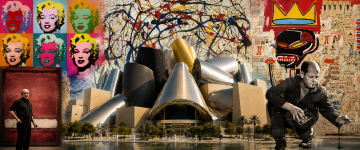
The names are familiar to art lovers: Jackson Pollock, Mark Rothko, Andy Warhol, Jean-Michel Basquiat. But here is what makes this museum different. As Mohamed Khalifa Al Mubarak, Chairman of the Department of Culture and Tourism – Abu Dhabi, explained, these icons will be displayed “right next to” artists who deserve more attention—artists from Southeast Asia, from Africa, from the Arab world, from regions that have often been marginalized in Western art narratives.
“We want to be unbiased in that,” he said, referencing gender and geography as factors that have historically shaped who receives recognition.
The collection is described as “uniquely local and global,” centred in the region but drawing from all continents. It reflects Abu Dhabi’s position at the crossroads of trade and cultural exchange that has defined this region for millennia.
Breaking the Chronology
Most art museums tell history in a straight line. Guggenheim Abu Dhabi refuses to do so.
Instead of a chronological timeline, the museum organizes its galleries around themes that create dialogue across time and place. These “vectors” of art since 1960 include:
- Abstractions
- Popular Culture
- Land
- Language
- Storytelling
This curatorial approach means a contemporary African artist might hang alongside an American abstract expressionist, connected not by when they lived but by what they explored. It is a deliberate effort to break down barriers between cultures, generations, and movements.

Dr. Mariët Westermann, Director and CEO of the Solomon R. Guggenheim Foundation, captured the vision beautifully: “The museum will be a source of wonder, a hub of connection, and a place of curiosity and joy for people from the United Arab Emirates and the world.”
A Museum for the People
Guggenheim Abu Dhabi is designed to be navigated on the visitor’s own terms. Guests can shape their own pathways through the galleries, engaging with art through relationships and resonances rather than being guided along a prescribed route.
Beyond the exhibition spaces, the museum includes dedicated facilities that signal its commitment to education and community: a centre for art and technology, specialized children’s educational spaces, historical archives, a research library, and an advanced conservation laboratory.
It is not merely a place to view art. It is a place to learn, to question, and to connect.
What This Means for Abu Dhabi
Guggenheim Abu Dhabi is a defining moment in Abu Dhabi’s cultural journey. Mohamed Khalifa Al Mubarak spoke of the emirate’s “long-held conviction that culture is the most enduring bridge between peoples and a building block for forward-looking societies.”
This opening further strengthens Abu Dhabi’s position as a leading global capital for the arts. Alongside its neighbouring institutions in the Saadiyat Cultural District, the museum transforms the city into a destination that rivals any cultural capital in the world.
Practical Details for Your Visit
- Opening Date: December 11, 2026
- Location: Saadiyat Cultural District, Saadiyat Island, Abu Dhabi
- Galleries: 30 indoor galleries + outdoor exhibition areas
- Key Artists: Jackson Pollock, Andy Warhol, Jean-Michel Basquiat, Mark Rothko, Yayoi Kusama
- Curatorial Theme: Thematic rather than chronological; exploring connections across cultures
A Final Thought
When Gehry spoke of his work, he said he was “looking for a way to express the times we lived in”—a time full of movement and change. Guggenheim Abu Dhabi, completed after his death, stands as perhaps the most profound expression of that vision.
It is a building that honours the past, through its vernacular-inspired design and its collection that centres voices from across the globe. It is a building that embraces the present, through its thematic curatorial approach that refuses simple answers. And it is a building that looks to the future, inviting generations to come to find wonder, connection, and joy within its walls.
On December 11, 2026, the doors open. The wait is over. And art, as it turns out, was worth the journey.
Comments